Sunday, June 10, 2012

Math Mammoth Success!


After carefully reviewing way too many curriculum samples, I settled on Math Mammoth.  I like that it's a mastery-based curriculum.  Your child won't just touch on a subject then rush off to something else.  I also liked that it's affordable!  Other deciding factors were it's easy open-and-go format and the fact that it's easy to either speed up or slow down depending on your needs.  Although some parents have complained that there are too many problems per page, the curriculum is designed so you don't have to do them all.  Once your child demonstrates that understands the concept, you can skip some of the problems.  If your child is struggling, you can do them all.

So far, it's been a big hit!  Crazy Bug successfully learned to tell time in two days!  The addition chapter was a little slow for her, and she's spending plenty of time practicing her facts on Xtra math, so I let her test out of that chapter.  (Testing out is when you let a child take the end of unit test before studying the material.  If the child can demonstrate mastery, he is able to skip the unit and move on or do enrichment work.)

We've also been spending plenty of family time playing the addition and subtraction games suggested in the curriculum.  They're super easy to create if you just have a deck of cards and a couple of dice on hand.  We've also been playing Smath, a Scrabble-like math game I found at a yard sale.  You could also try the vintage math game Quizmo if you can get your hands on a copy.


Friday, June 8, 2012

Picasso Artist Study

This week we tackled Pablo Picasso for our artist study.  Picasso's variety of styles and lively personality should capture your kids' attention.  There are also so many great resources available for this unit!

Kristen over at Teaching Stars recommended some fantastic picture books that mix fiction with non-fiction.  Until I visited her blog, I'd never realized there were so many picture books about artists available!  Check out her Picasso study here for more ideas.

We read:
Pablo Picasso: Breaking All the Rules (Smart About Art), by True Kelley
Picasso and Minou, by P. I. Maltie
When Pigasso Met Mootisse, by Nina Laden
Picasso and the Girl with the Ponytail, by Laurence Anholt


I highly recommend When Pigasso Met Mootisse if you've studied both artists.  It's a very funny read. (At least if you like puns.  And I do, oh, I do.  Much to my husband's dismay.)

Next Crazy Bug had a choice of painting a picture inspired by Picasso's Blue Period or Rose Period.  We talked about how Picasso used colors express his emotions.  Crazy Bug was also able to explore how many, many shades of color there are in the world.  Basically, choose a subject to paint that makes you feel either happy (Rose Period) or sad (Blue Period).  Then use just red or blue paint mixed with various amounts of white, black, and brown to create all the different shades for your painting.

Here's my example of a Blue Period picture.  The blues nicely convey the loneliness of the dog.  Oddly, the colors look very different in the photo than they do in real life.  The dog, the tree trunk, and the moon are much more blue in the actual picture.


And here's Crazy Bug's (much more abstract) picture of a raspberry bush.  Raspberries not only make her happy, she told me, but they are also easy to paint with red!


Our next project was creating a Cubist style picture.  We used a couple of Crazy Bug's stuffed animal friends as models.  I reminded her (many times) that Cubism was about exploring new ways of seeing things, so she shouldn't worry about trying to create a realistic portrait of Teddy.  Instead, we focused on using geometric and free form shapes.  I also encouraged Crazy Bug to let her feelings about Teddy guide her color choices.  Apparently, Teddy makes her "excited-happy" so she chose "party" colors to communicate that.


Thursday, June 7, 2012

How To Find the Right Level Readers for Your Child

Have you looked at the leveling systems for easy reader books lately?  The levels have gone haywire.  Every publisher uses its own system to determine reading levels, and they vary widely from publisher to publisher.  This can make it nearly impossible to determine which books are appropriate for your kiddo.  That's why I was psyched when I stumbled upon the Accelerate Reader website.  The Accelerated Reader system provides consistent level information for all books!  It's incredible easy to use.  Just go to the AR Bookfinder and type in a book title.  Look for the book level (BL).  You may also want to make sure the interest level (IL) is appropriate.  If you're looking for new titles, you can do an advanced search where you can set the book level and genre.  You'll get a lovely list that you can take over to Amazon or your local library!

Here are some examples:


BL .06    BL 1.2   BL 2.4
BL 3.5    BL 4.6     BL 5.5 

I find searching for books by level particularly helpful when I am trying to challenge my daughter.  It allows me to choose books that are just a little bit harder than what she's used to so she will be challenged but not discouraged.  I hope you find this resource as valuable as I have!

Wednesday, June 6, 2012

Story of the World: Chapter 1

This weekend we read The Story of the World, Chapter 1: The Earliest People.  It told us about the nomads and how some of them came to settle in the Fertile Crescent.  Crazy Bug particularly liked the parts about the girl, Tarak, bringing home lizards for her mother to make into stew.

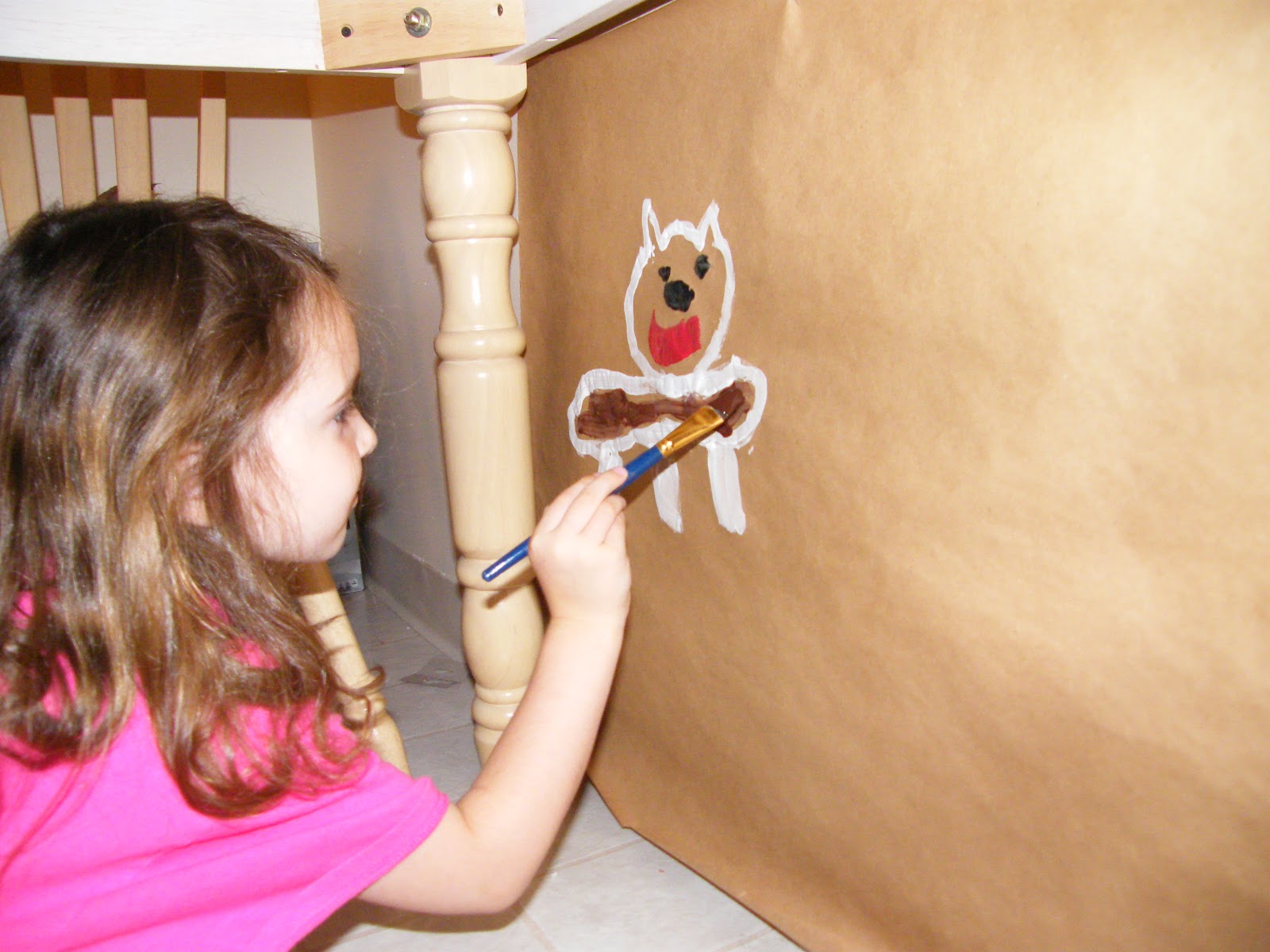
Our project was to make cave paintings like the ones the nomads made.  Our "cave" was underneath the kitchen table.  I taped brown packaging paper to the walls and pulled out some black, brown, red, and white paint.  We painted animals and animal hunts.  This led into a long session of imaginative play, where Crazy Bug hunted,gathered, and built a Lincoln Log fire so we could cook our lizard stew.


Our extra reading choices this week were The Cave Painter of Lascaux and Digging Up History (Usborne Beginners) .  The first book was not a hit, but the second one was.  After our pretend archaeology dig last week, Crazy Bug marveled at how archaeologists dug out entire cities.  The Usborne Beginners books also have internet links for more information, so we played an archaeology game online.  Crazy Bug had to act like a real archaeologist and try to determine what various artifacts were used for.  She discovered that it's harder than one might think!

Sunday, June 3, 2012

Story of the World: Introduction

Crazy Bug had so much fun with our first Story of the World chapter!  We started by reading the introduction together.  Then I asked Crazy Bug a few questions to help her summarize what she learned.  Our conversation went something like this:

Me:  What is history?
CB:  History is the story of people who lived a long, long, long time ago.
Me:  How do we learn about history?
CB:  By letters and carvings.
Me:  Can you say a whole sentence about that?  We learn..."
CB: We learn about history by reading letters and carvings that people wrote a long time ago.

Next we read a story to learn more about what archaeologists do.  I highly recommend Archaeologists Dig for Clues by Kate Duke.  Although it's a bit longer than Crazy Bug's usual tolerance for nonfiction, she was fascinated!  She couldn't wait to go on our own "archaeological dig".


I gathered up some artifacts from around our house and we headed down to a deserted beach.  We used sticks and string to make a 3x3 grid in the sand.  I buried the objects, then Crazy Bug carefully dug them up, brushed them clean, and recorded the objects and their locations on our log.  Each item was placed in a carefully labelled bag for the trip back to the "laboratory".  We imagined we were archaeologists from the future and tried to learn as much as we could from the items.  ("This envelope has printing on it!  They must have known how to print things and had a mail service!")


I have to say, I've seldom seen Crazy Bug quite so excited as she was about this dig!

Saturday, June 2, 2012

Diving Into Ancient History

We've finally dived into our world history curriculum and I couldn't be more thrilled!  We are using The Story of the World: Volume 1 , which is part of a four volume cycle that takes children from the earliest people through modern times.  There's nothing textbook-y about this book!  SOTW treats history like an intriguing story.  The author, Susan Wise Bauer, stresses that at this age we shouldn't aim for mastery of the subject.  Instead we are simply exposing our children to world history in order to give them a background they'll later build on.  The book is supplemented with a wonderful activity guide and many outside reading recommendations.

Some people might feel that a world history curriculum is too dry for this age group.  I've hear many people say that they'd rather their children have time to play and just be kids.  These things are not mutually exclusive!  After reading the chapter on cave dwellers, Crazy Bug spent hours pretending to live in a cave.  As we played, she frequently asked questions about how the cave dwellers ate, cooked, and made tools.  Before this, she hadn't played make believe games for a while because she'd grown bored with all the scenarios she could imagine.  Learning about history actually enlivened and reignited her creative play!  To me, that's exactly what education is about!  It gives children the skills and information they need to enjoy their world.

As you explore the activities shown on my blog, try to keep that goal in mind.  I don't teach my daughter about Chihuly and Matisse so she can recite their biographies back to me.  I teach her about them so she can discover new styles and materials to create with.  She doesn't get bored by pulling out the same watercolor set over and over again.  Instead she is constantly inspired by new ideas!  Likewise, I don't teach her how to write just to make her seem smart.  Her head is filled with so many ideas and thoughts that she wants to share.  Learning to write allows her to express herself clearly so she can communicate her thoughts to others.

Don't be afraid of education.  No, we should not sit our young children down at desks and overwhelm them with worksheets, drills, and rote memorization.  But that doesn't mean we shouldn't teach them!  Instead, do a little teaching, then let them use and explore the knowledge they've learned.  The result?  Happy, eager, curious kids who have a strong foundation for their creative pursuits!