Wednesday, June 6, 2012

Story of the World: Chapter 1

This weekend we read The Story of the World, Chapter 1: The Earliest People.  It told us about the nomads and how some of them came to settle in the Fertile Crescent.  Crazy Bug particularly liked the parts about the girl, Tarak, bringing home lizards for her mother to make into stew.

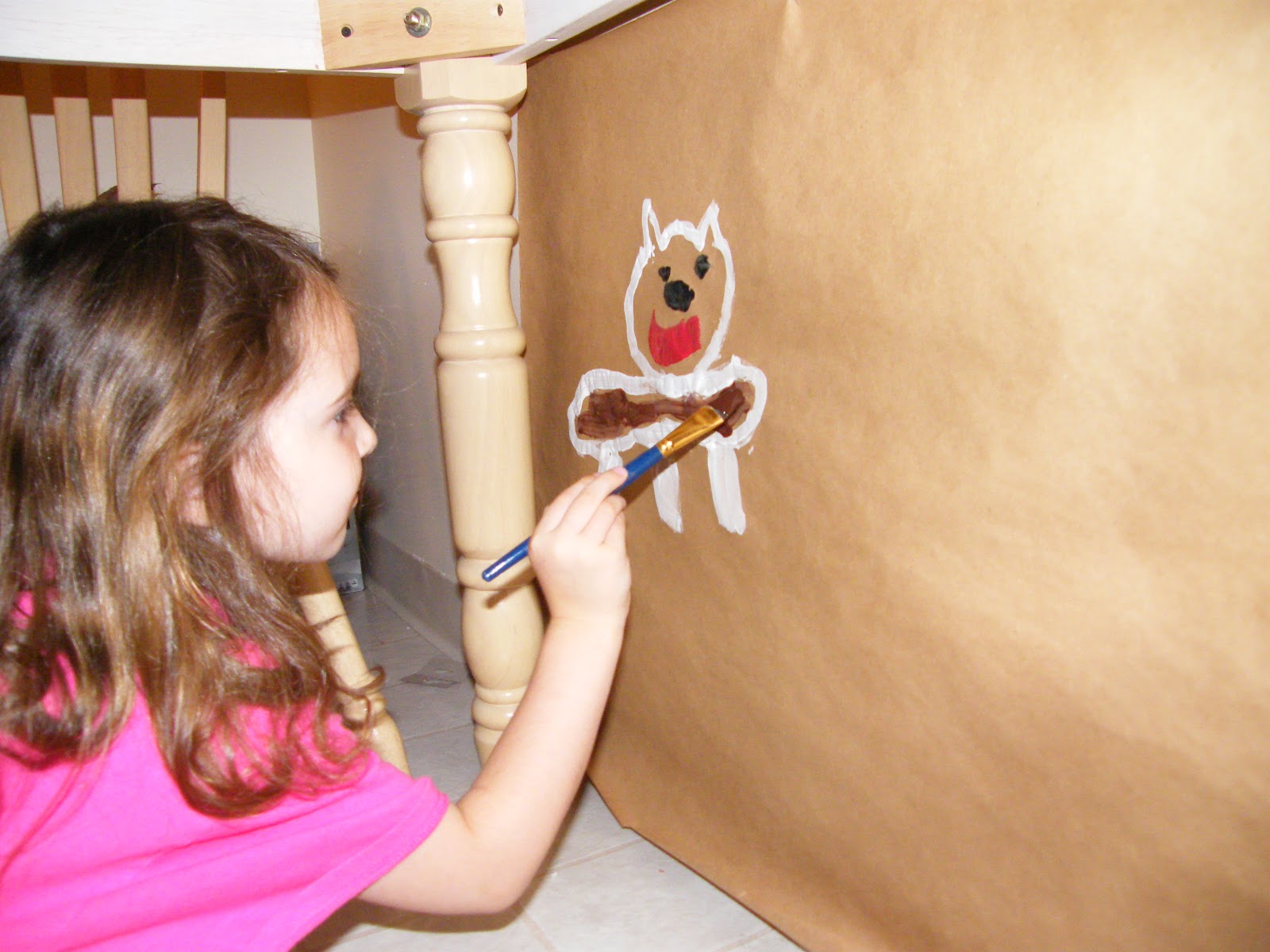
Our project was to make cave paintings like the ones the nomads made.  Our "cave" was underneath the kitchen table.  I taped brown packaging paper to the walls and pulled out some black, brown, red, and white paint.  We painted animals and animal hunts.  This led into a long session of imaginative play, where Crazy Bug hunted,gathered, and built a Lincoln Log fire so we could cook our lizard stew.


Our extra reading choices this week were The Cave Painter of Lascaux and Digging Up History (Usborne Beginners) .  The first book was not a hit, but the second one was.  After our pretend archaeology dig last week, Crazy Bug marveled at how archaeologists dug out entire cities.  The Usborne Beginners books also have internet links for more information, so we played an archaeology game online.  Crazy Bug had to act like a real archaeologist and try to determine what various artifacts were used for.  She discovered that it's harder than one might think!

Sunday, June 3, 2012

Story of the World: Introduction

Crazy Bug had so much fun with our first Story of the World chapter!  We started by reading the introduction together.  Then I asked Crazy Bug a few questions to help her summarize what she learned.  Our conversation went something like this:

Me:  What is history?
CB:  History is the story of people who lived a long, long, long time ago.
Me:  How do we learn about history?
CB:  By letters and carvings.
Me:  Can you say a whole sentence about that?  We learn..."
CB: We learn about history by reading letters and carvings that people wrote a long time ago.

Next we read a story to learn more about what archaeologists do.  I highly recommend Archaeologists Dig for Clues by Kate Duke.  Although it's a bit longer than Crazy Bug's usual tolerance for nonfiction, she was fascinated!  She couldn't wait to go on our own "archaeological dig".


I gathered up some artifacts from around our house and we headed down to a deserted beach.  We used sticks and string to make a 3x3 grid in the sand.  I buried the objects, then Crazy Bug carefully dug them up, brushed them clean, and recorded the objects and their locations on our log.  Each item was placed in a carefully labelled bag for the trip back to the "laboratory".  We imagined we were archaeologists from the future and tried to learn as much as we could from the items.  ("This envelope has printing on it!  They must have known how to print things and had a mail service!")


I have to say, I've seldom seen Crazy Bug quite so excited as she was about this dig!

Saturday, June 2, 2012

Diving Into Ancient History

We've finally dived into our world history curriculum and I couldn't be more thrilled!  We are using The Story of the World: Volume 1 , which is part of a four volume cycle that takes children from the earliest people through modern times.  There's nothing textbook-y about this book!  SOTW treats history like an intriguing story.  The author, Susan Wise Bauer, stresses that at this age we shouldn't aim for mastery of the subject.  Instead we are simply exposing our children to world history in order to give them a background they'll later build on.  The book is supplemented with a wonderful activity guide and many outside reading recommendations.

Some people might feel that a world history curriculum is too dry for this age group.  I've hear many people say that they'd rather their children have time to play and just be kids.  These things are not mutually exclusive!  After reading the chapter on cave dwellers, Crazy Bug spent hours pretending to live in a cave.  As we played, she frequently asked questions about how the cave dwellers ate, cooked, and made tools.  Before this, she hadn't played make believe games for a while because she'd grown bored with all the scenarios she could imagine.  Learning about history actually enlivened and reignited her creative play!  To me, that's exactly what education is about!  It gives children the skills and information they need to enjoy their world.

As you explore the activities shown on my blog, try to keep that goal in mind.  I don't teach my daughter about Chihuly and Matisse so she can recite their biographies back to me.  I teach her about them so she can discover new styles and materials to create with.  She doesn't get bored by pulling out the same watercolor set over and over again.  Instead she is constantly inspired by new ideas!  Likewise, I don't teach her how to write just to make her seem smart.  Her head is filled with so many ideas and thoughts that she wants to share.  Learning to write allows her to express herself clearly so she can communicate her thoughts to others.

Don't be afraid of education.  No, we should not sit our young children down at desks and overwhelm them with worksheets, drills, and rote memorization.  But that doesn't mean we shouldn't teach them!  Instead, do a little teaching, then let them use and explore the knowledge they've learned.  The result?  Happy, eager, curious kids who have a strong foundation for their creative pursuits!

Tuesday, May 29, 2012

Math Enrichment Resources

A few weeks ago I asked Crazy Bug what she wanted to do this summer.  I expected the typical responses: swim, go to Six Flags, camp.  Instead she said, "Math! Lots and lots and lots of math."  So math it is!

We are currently using Math Mammoth 1b as our basic curriculum.  It's a nice, steady, easy to implement mastery-based approach to math.  I love that you can just open it up and go because I don't have time for lots of planning.  While its nice to know the basics are covered and Crazy Bug is not missing any concepts, I have to admit that Math Mammoth is a bit dull.  So I supplement with other materials that increase critical thinking skills and mix up the material a bit.

Here are some terrific supplements:

Sunshine Math is a program created by the Florida Department of Education to challenge advanced students.  The worksheets are available for free online.  Each worksheet has a mix of concepts and problem types, and many explore concepts outside of the general grade-level curriculum.

Singapore Math's Challenge Word Problems is another great resource.  Word problems ensure that your child not only understands how to do math, but also when and how to use each concept.  These problems are a little tough, so you may need to go down one level from your child's general math level.  Be prepared to provide support and assistance while your child adjusts to this type of problems.

Critical Thinking Company offers a large variety of math and non-math resources.  They all challenge children to expand their ways of thinking about and solving problems.  This year I'm using Mathematical Reasoning Level B and Building Thinking Skills Level 1, as time allows.

Dr. Wright's Kitchen Table Math: Book 1 is the first in a series of three books for elementary school children and their parents.  The three books span the entire elementary school math curriculum with easy, hands-on math activities to do at home.  If your child is a tactile learner, then this is a great place to start.  Personally, we have only used Book 3, which focuses on non-arithmetic math: geometry, problem solving, probability, graphing, and more.

Saturday, May 26, 2012

To Be Continued...

This is the last week before the final SAT exam of the year, so life's a little crazy around here right now.  Afterschooling is temporarily on hold while I race from appointment to appointment.  We'll pick up again next week and I'll have some new posts for you then, like a Picasso study, our first Story of the World chapters, and more math enrichment!

Wednesday, May 23, 2012

Chihuly Artist Study


Dale Chihuly is a glass artist who makes beautiful, colorful, gigantic glass pieces that fascinate kids.  He's also an exciting artist to study because he's still alive and creating.  And he looks like a pirate.  I'd never even heard of him until Crazy Bug and I went to the MFA.  In the middle of the museum there is a 40 ft glass sculpture entitled Lime Green Icicle Tower.  It's incredible to look at up close.  It glows in the the light on a sunny day.                                                                                                             Since Chihuly is a recent artist, we couldn't find a children's biography about him.  But the Indianapolis Children's Museum came to the rescue with their Chihuly unit for teachers.  It includes a two page biography that worked perfectly for us.  There are also online games and videos that allow children to explore glass work.


Our first project was to make "glass" bowls that explore color mixing.

Materials:
Coffee filters
Washable markers
Water mister
Spray starch (try your local dollar store for a can)
Glasses, bowls, or tupperware
Newspaper

The process is pretty simple.

1.  Have your child decorate a coffee filter with markers.  Try different color combinations and patterns.  Feels free to swirl the colors all around each other.

2.  Mist the coffee filter lightly with water to help the colors start mixing.

3.  Lay down some newspaper and place upside-down glasses, bowls, or tupperware on top.

4.  Put each coffee filter over a bowl or glass and spray it with starch.  Use your finders to fold and mold the coffee filters into interesting shapes.


Crazy Bug loved this project so much that she made dozens of bowls.  They lay around our house until my mother suggest using them to make a flower garden on Crazy Bug's bedroom door.  I trimmed some green paper into a grass border and taped it to the bottom of the door, then added thick green ribbon stems.  We then tapped the bowls to the top of the stems to make flowers.  Too cute!

The second project was to make a free form "glass'' installation.  I picked up cheap clear plastic cups and stemmed glasses at the Dollar Tree and we colored them with permanent markers.  (Medium to light colored markers look best.  We painted the inside a few of the ones shown here with acrylic paint, but those turned out too dark and matte for my taste.)  I then placed them on a foil covered cookie sheet and broiled them for a couple of minutes until they started to melt.  Watch carefully and open all your windows!  Afterwards, I hot glued them together and hung them with strong thread.  This looks beautiful hung in front of a window where it will catch the light!


If you like near Indianapolis, go check out Fireworks of Glass!  We'll be soooo jealous!


*I selected this post to be featured on Education Blogs. Please visit the site and vote for my blog!*

Monday, May 21, 2012

Early SAT Prep 2: Math

SAT math and high school math are very different animals.  In high school, students study one concept at a time, from one area of math.  For example, most students take a year of geometry.  During that year they might study angles, then triangles, then polygons, then circles.  After studying a concept for a couple of weeks, they're tested on that concept.  For the test, they mainly have to recall the information learned over the prior few weeks and apply it over and over again in slightly different ways.

The SAT tests dozens of concepts from different areas of math.  What's more, many problems test multiple concepts within one problem!  Students can't simply regurgitate the same information again and again.  They have to use their critical thinking skills to evaluate the information provided and determine the concepts, equations, or strategies necessary to solve the problem.

Student who do well on the SAT are not necessarily the ones who receive the highest scores on their classroom tests.  But they are the ones who understand how math works.  They are the ones who can reason out an answer even without a handy-dandy formula.

So how can you help prepare your child?  Here are some tips:

Know the Facts
The SAT is a timed test and every minute counts.  So having basic math facts memorized obviously helps.  Yes, students can use calculators, but calculators are easy to confuse.  Hit plus instead of minus or add an unnecessary decimal and your answer is thrown off.  I've seen many many students multiply 36 x 9 and get 4 without realizing that something strange is going on.  I love the free site XtraMath for memorizing facts.  It's simple, graphic free, and kind of boring, but it gets the job done!

Work the Word Problems
The SAT is the wordiest math test you'll ever see.  Many students can't even figure out what the problem is asking them to do, much less how to solve it.  Public schools do spend more time on word problems than they used to, but it's still not enough.  Particularly at higher levels.  Two useful resources are Singapore's Challenge Word Problems workbooks and The Art of Problem Solving curriculum.

Don't Give Partial Credit
Teacher's often give students partial credit if they solve the problem the right way but make a calculation error.  The SAT does not, and for good reason!  I remember watching my husband and father-in-law build radiator covers for our old house.  They knew how to do the calculations, but kept making minor mistakes.  Much cursing ensued when the resulting radiator covers didn't fit over the radiators.  There's not such thing as a "partially correct" answer to a math problem!


Mix It Up
While new concepts clearly need to be taught one at a time, it doesn't mean students should only work on one type of problem at a time.  Every lesson should end with review problems from several different areas.  And as students get older, problems should be multi-step and multi-concept.  For example, the SAT often gives students the area of a square inscribed in a circle, then asks for the circumference of the circle.  Students must use their knowledge of area to find the length of the square's sides.  Then they must use their knowledge of right triangles and squares' diagonals to find the length of the diagonal.  This in turn is used to find the circle's radius, which is then (finally!) used to calculate circumference.  See why your teenager's head is spinning?


Don't Wait to Get Help
If your son or daughter is struggling with math, don't delay getting help or hire a "homework tutor."  I have frequently been asked by parents to tutor their children by helping them with their homework each day.  I see two problems with this.  First, it's just treading water.  Students who are struggling generally need to go back to the basics and move slowly forward from there, filling in gaps in knowledge and skills as they go.  Second, it teaches the student to be dependent on outside help.  Tutors should help students master concepts so that they can do homework problems (which are designed as practice) on their own.  Math continues to build each year, so getting your child help with pre-algebra will be much more useful then trying to diagnose what she's missed when she's in algebra II.

I hope these ideas help!  If you have other ideas or resources, let me know and I'll try to add them in.